

Chinese Calendar Explained: Lunar Dates and Leap Months
Convert Gregorian and lunar dates with the Chinese calendar converter, calculate lunar age, and understand leap months, festival dates and zodiac year boundaries.

–8 min read

Chinese Calendar Explained: Lunar Dates and Leap Months
Convert Gregorian and lunar dates with the Chinese calendar converter, calculate lunar age, and understand leap months, festival dates and zodiac year boundaries.
–8 min read
Chinese Calendar Converter
What Is the Chinese Calendar?
The Chinese calendar, or Nongli (农历), is China's traditional lunisolar calendar. That means it uses both the Moon's cycle and the Sun's seasonal cycle.
Each month begins with a new moon. Solar terms mark the Sun's progress through the year, and occasional leap months keep the calendar in step with the seasons. The Hong Kong Observatory explains how these lunar and solar rules work together.
Chinese lunar calendar is a common name for this same system. A purely lunar calendar counts months by the Moon and lets them move through the seasons. The Chinese calendar adjusts for the solar year as well.
The Gregorian calendar follows the solar year, with months that begin independently of the Moon's phases. We can give the same day a date in either system. The two entries on a calendar refer to that same day; the month and day numbers usually differ.
You may use a Gregorian date to make plans and a lunar date to check when Chinese New Year falls. The festival's Gregorian date changes each year. To read the lunar entry, you need to recognize its year, month and day.
How to Read a Chinese Calendar Date
The lunar date "month 8, day 15" does not mean August 15. Lunar months begin with new moons, so the eighth lunar month has different start and end dates from August in the Gregorian calendar.
The year matters when converting a lunar date to a Gregorian date. For example, in 2026, lunar month 8, day 15 falls on September 25. The same lunar month and day in 2027 fall on a different Gregorian date.
Some years include an additional month that repeats the previous month's number. In a year with a leap fourth month, the regular fourth month comes first, followed by the leap fourth month. The label "leap month 4" distinguishes it from the regular fourth month. Without "leap," the date would refer to the regular fourth month instead.
In Chinese, the month-and-day pair in our example is 八月十五. 月 marks the month, and 十五 gives the day. Other common labels include:
| Chinese label | Meaning |
|---|---|
| 正月 | Lunar month 1 |
| 冬月 | Lunar month 11 |
| 腊月 | Lunar month 12 |
| 初十 | Day 10 |
| 十五 | Day 15 |
| 廿三 | Day 23 |
| 三十 | Day 30 |
| 闰 (閏) | Leap month; 閏 is the traditional character |
In day labels, 初 appears in the names of the first ten days, and 廿 means twenty. 闰四月, written 閏四月 in traditional characters, labels the additional fourth month.
Why Lunar Months and Leap Months Change
Lunar Months and the Solar Year
A lunar month begins on the day of a new moon. New moons are about 29.53 days apart on average, but calendar dates count whole days. That gives each lunar month 29 or 30 days.
Twelve lunar months add up to about 354 days. A solar year is about 365 days, leaving a gap of roughly 11 days. If every lunar year had only 12 months, its dates would gradually shift through the seasons. Occasional leap months keep that shift from continuing year after year.
An ordinary Chinese lunar year has 12 months, and a year with a leap month has 13. The extra month gives the lunar calendar more time to catch up with the seasonal year. A Gregorian leap year adds just one day, February 29.
How Leap Months Are Placed
The 24 solar terms mark the Sun's progress through the seasons. They alternate between minor terms (jie) and major terms (zhongqi), with 12 of each. The major terms are the ones used in the leap-month rule.
Under China's calendar standard, GB/T 33661-2017, the month containing the winter solstice is always lunar month 11. That month is the starting point for the leap-month rule.
The count starts with that month 11 and ends before the next month 11 begins. If this span has 13 months, the first month without a major solar term is the leap month. A month without a major term in a span of only 12 months remains a regular month.
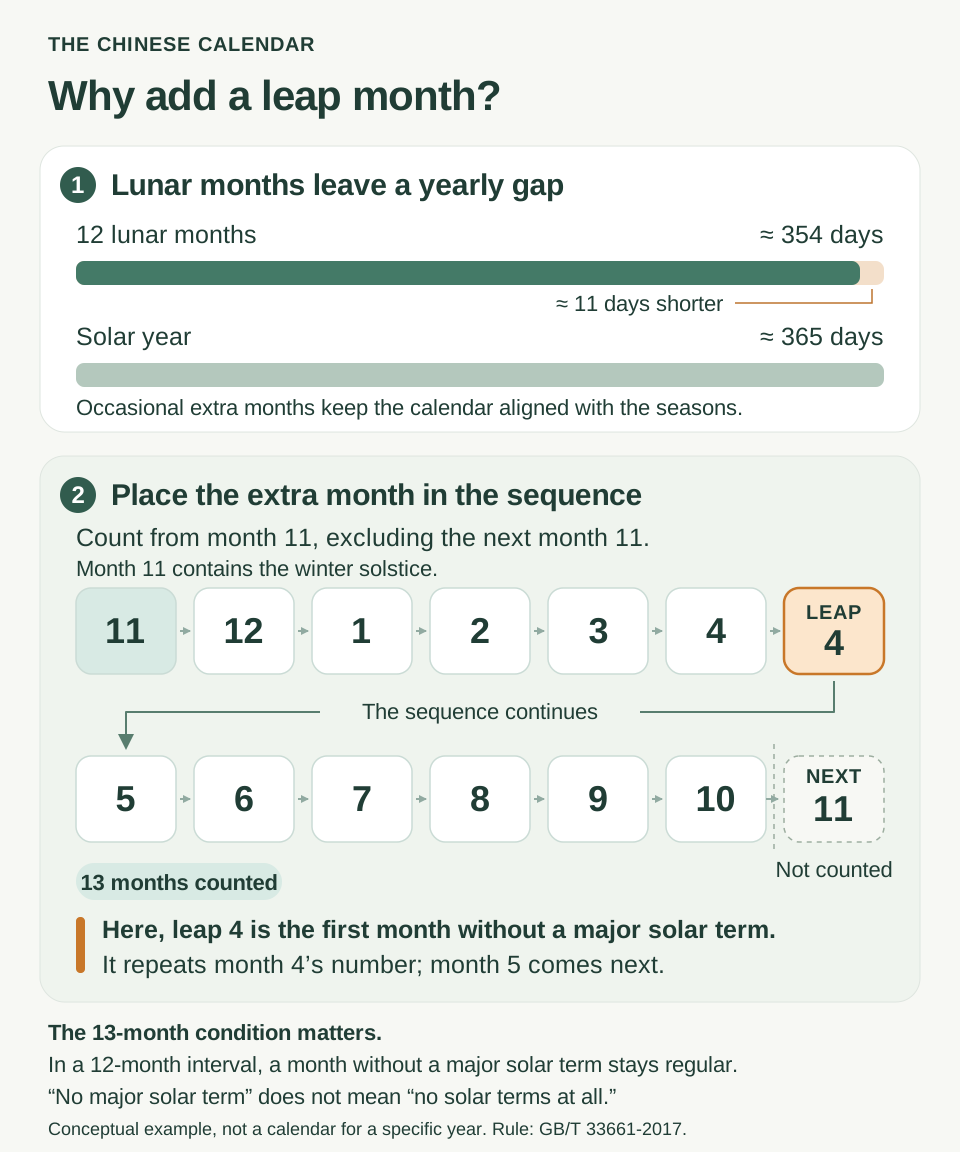
After month 11, the regular month sequence continues with month 12, then month 1. Any leap month in between adds time without advancing that sequence. Chinese New Year begins on the first day of month 1.
A year of 12 lunar months is shorter than a Gregorian year, so the next Chinese New Year arrives earlier on the Gregorian calendar. A year with 13 months is longer, so the next New Year arrives later. These differences in year length give the festival a different Gregorian date from year to year.
Lunar Festival Dates and Qingming
Dragon Boat and Mid-Autumn follow fixed lunar dates, while Qingming follows a solar term:
| Festival | Date rule |
|---|---|
| Dragon Boat Festival | Day 5 of regular lunar month 5 |
| Mid-Autumn Festival | Day 15 of regular lunar month 8 |
| Qingming | The day of the Qingming solar term; no fixed lunar month and day |
Qingming's Gregorian date stays near the beginning of April because it follows a solar term. It falls on April 5 in 2026; Mid-Autumn Festival falls on September 25 that year. The Hong Kong Observatory's annual conversion tables provide the corresponding Gregorian and lunar dates for each year. Public holiday schedules may include additional days off beyond the festival date itself.
Chinese Zodiac Years and the New Year Boundary
The Chinese Calendar in 2026
The Chinese lunar year beginning in 2026 is the Year of the Horse, named Bing-wu (丙午). The Hong Kong Observatory's annual calendars give the following first and last Gregorian dates for that lunar year and the next one:
| Lunar year beginning in | First day (Gregorian) | Last day (Gregorian) |
|---|---|---|
| 2026 | February 17, 2026 | February 5, 2027 |
| 2027 | February 6, 2027 | January 25, 2028 |
January 2027 still belongs to the lunar year that began in 2026.
Zodiac Animals and the 60-Year Cycle
The twelve zodiac animals repeat in this order: Rat, Ox, Tiger, Rabbit, Dragon, Snake, Horse, Goat, Monkey, Rooster, Dog, Pig.
Each animal corresponds to one of twelve Earthly Branches, a set of traditional year labels. A full year name pairs a branch with one of ten Heavenly Stems. In Bing-wu, Bing (丙) is the stem and wu (午) is the branch associated with the Horse.
Both sequences advance by one position each year. The Horse returns every twelve years, paired with a different stem each time. The same stem and branch pair, such as Bing-wu, returns every sixty years.
January and February Birthdays: Chinese New Year or Start of Spring?
For a January or February birth, the Chinese New Year date matters. Someone born on February 10, 2026, was born in the previous lunar year. Someone born on February 20, 2026, was born in the Year of the Horse.
Both people were born in February 2026, but their birthdays fall in different lunar years. The birth year and full date matter when assigning a zodiac animal.
The Hong Kong Observatory explains the two year boundaries: the civil lunar year begins on the first day of lunar month 1, while some astrological traditions use Start of Spring, or Lichun. In 2026, Start of Spring falls on February 4 and Chinese New Year on February 17.
A February 10, 2026, birthday falls between those boundaries. Under a Start of Spring convention, it is already in the new Horse year; under the civil lunar calendar, it is still in the previous year. The difference comes from the chosen year boundary. This article uses Chinese New Year for civil lunar year labels.
Lunar Age and Chinese Pregnancy Calendar Charts
What Does Lunar Age Mean?
In Chinese pregnancy charts, lunar age refers to a traditional age count, often called xusui (虚岁). Under the common Chinese New Year convention, a child is counted as one at birth and gains another year at each Chinese New Year. Everyday age counts completed years since birth and increases on birthdays.
For example, a child born on February 16, 2026, would be counted as one at birth. Chinese New Year falls the next day, February 17, so the child's traditional age would become two, even though the child is only one day old. Adding one to their age in completed years, still zero, would give one instead of two.
Pregnancy charts may define their age inputs differently. The chart's instructions determine how to count the mother's age and which date to use.
Lunar Age Calculator
Chinese New Year convention: one at birth, one more at each Chinese New Year.
Dates: 1901–2100. Today uses your device’s local date.
What Is a Chinese Pregnancy Calendar Chart?
In pregnancy searches, "Chinese calendar" often means a traditional chart that claims to predict a baby's sex. It uses the mother's age and the month of conception as inputs.
Age appears along one side of the chart and conception months along the other. The cell where they meet gives the chart's prediction. Its instructions determine how age is counted, which calendar it uses for the conception month and how it handles leap months.
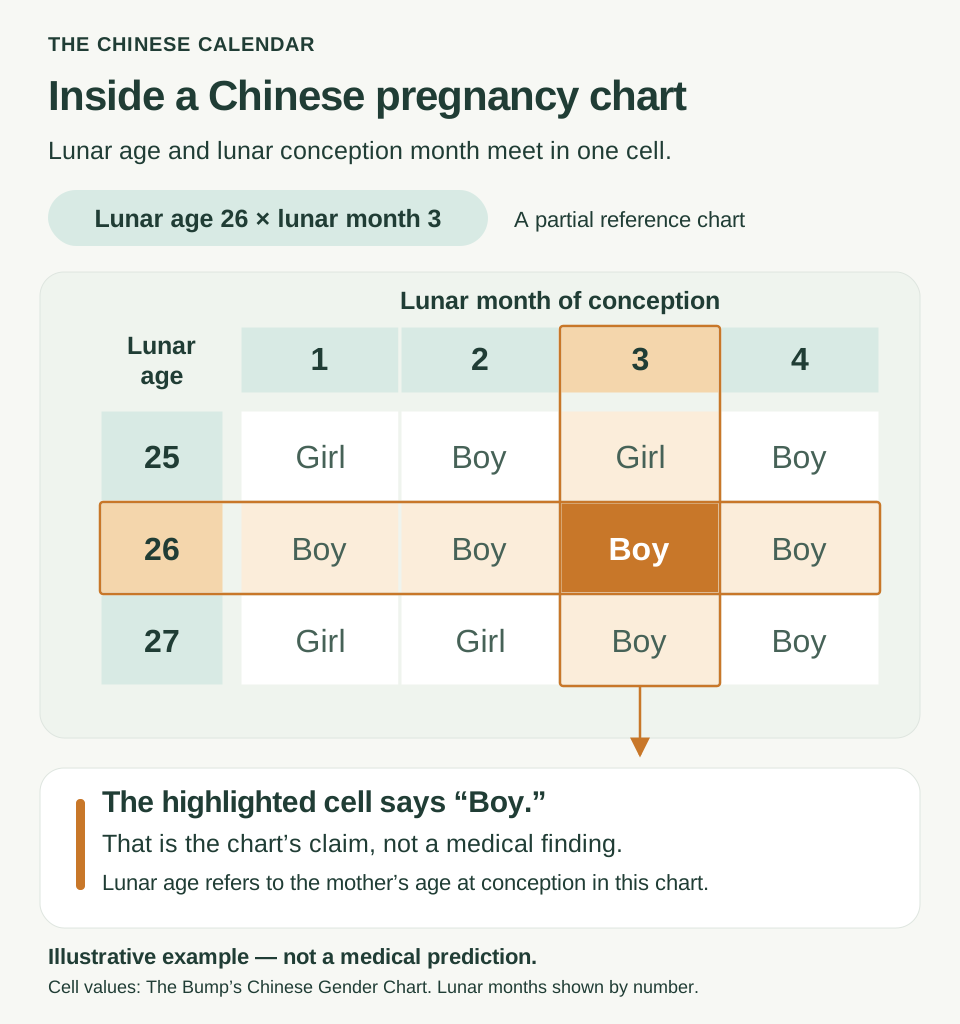
A due date refers to the expected birth, several months after conception. Its month is not the conception-month input in such a chart.
How Accurate Are These Charts?
The Chinese calendar prediction method tested in a 2010 study by Villamor and colleagues performed no better than chance. The researchers analyzed 2,840,755 singleton births in Sweden from 1973 to 2006, using the mother's lunar age and month of conception to predict the baby's sex.
Official annual tables let us check a Gregorian date against its lunar date. The study above tests a different claim: whether age and conception month can predict a baby's sex. A correct date conversion alone does not make that prediction accurate.
The Chinese calendar combines lunar months with the seasonal year. A full lunar date, including its year and any leap-month label, identifies a day that also has a Gregorian date. That relationship helps us understand why lunar festivals fall on different Gregorian dates each year and why a zodiac year can span parts of two Gregorian years.
Written by
Richie Shi
I’m Richie. I help foreigners solve problems related to China. Feel free to reach out directly.
Recommended articles
All guidesHow to Book Hotels in China as a Foreigner: 2026 GuideCompare Trip.com, Agoda, Booking.com, Expedia and local hotel apps, then avoid issues with foreign guest policies, passports, credit cards and deposits.Richie Shi China SIM Card, eSIM or Roaming? 2026 Guide for ForeignersCompare China SIM cards, eSIMs, and roaming in 2026, with airport vs city buying tips, carrier choices, passport rules, and VPN advice.Richie Shi
 How to Book China High-Speed Rail Tickets in 2026Book China high-speed rail tickets as a foreigner with passport tips, Trip.com vs 12306, 15-day sales, reservations, payment options, and boarding steps.Richie Shi
China SIM Card, eSIM or Roaming? 2026 Guide for ForeignersCompare China SIM cards, eSIMs, and roaming in 2026, with airport vs city buying tips, carrier choices, passport rules, and VPN advice.Richie ShiHow to Book China High-Speed Rail Tickets in 2026Book China high-speed rail tickets as a foreigner with passport tips, Trip.com vs 12306, 15-day sales, reservations, payment options, and boarding steps.Richie Shi